Thursday, February 19, 2015

BELLS PALSY (Facial nerve injury)

A young undergraduate had come for pre-entrance medical examination; she satisfied all the conditions for medical certification of fitness, X-rays, blood and visual tests, etc. A closer look showed that her mouth had turned to one side, with the eyelids unable to close on the affected side.

Thereafter, I engaged her in a conversation. She said she had rashes about three months before then and it was treated at home through self-medication. Thereafter, she noticed the turning of her mouth and eye to one side.
The unfortunate girl had suffered from a condition called Bell’s palsy, a complication of untreated herpes skin infections which she suffered three months earlier.
She never bothered to see any doctor due to financial constraint. After the encounter, she was first referred to a neurologist for assessment and then to a physiotherapist because of the disability involved.
Bell’s palsy is a condition that causes temporary weakness or paralysis of the muscles on one side of the face. It is the most common cause of facial paralysis.
It is common with young adults of either sex, and they are more susceptible, for unknown reasons. Bell’s palsy resolves completely in around 90 per cent of cases, given time.
The facial nerve services the muscles of the face, the ears, salivary and tear glands, and also provides some of the sensations of taste on the tongue.
In Bell’s palsy, the facial nerve swells and the resulting inflammation disrupts the relay of nervous system messages which interferes with the nerve’s proper functioning. The paralysis can be partial or total.
Bell’s palsy is more common in pregnant women and those with diabetes and HIV for reasons that are not yet fully understood.
Causes
The reason for the swelling is unknown, although it is thought that the inflammation and swelling of the facial nerve is caused by some type of viral infection or autoimmune system response.
It is caused by swelling of the facial nerve at the point where it passes through a small opening in the skull.
A variety of other conditions can cause facial paralysis, including trauma, stroke, certain tumours and infections.
Symptoms of Bell’s palsy
Bell’s palsy is characterised by a droopy appearance around the eye and mouth on the affected side of the face. The symptoms include:
  • paralysis or weakness on one side of the face
  • numbness
  • pain around the ear
  • the eye can’t fully close
  • the mouth droops
  • the face feels heavy
  • foods taste slightly different.
Diagnosis
It is important to rule out these other potential causes. Bell’s palsy is diagnosed in a number of different ways, including clinical examination.
The person is typically asked to raise their eyebrows, close their eyes and smile. If the person has Bell’s palsy, their eyebrows will rise asymmetrically, they won’t be able to close the affected eye and one side of the mouth will droop.
Special scans, including CT and MRI scans, may be used to exclude other causes.
Treatment
The majority of people with Bell’s palsy – around 90 per cent – will recover completely with time, although the paralysis may last for up to one year in severe cases. However, the remaining 10 per cent will experience some degree of permanent paralysis.
Older people with pre-existing high blood pressure are at greater risk of this complication.
Early treatment with corticosteroids helps reduce the swelling of the facial nerve and severity of the disease.
Other treatment options can include:
  • artificial tears to keep the affected eye lubricated
  • a patch to protect the affected eye
  • using tape to close the affected eyelid at night
  • medications such as corticosteroids to help reduce the swelling of the facial nerve
  • pain-relieving medications
  • Physiotherapy
  • massage
  • facial exercises
Prevention
Viral infections, Herpes, HIV, etc. should be treated promptly.
Blood pressure and blood sugar should be controlled.
Please visit my blogspot: www.doctoradesanya.blogspot.com for more health tips.

Tuesday, February 3, 2015

Managing men’s health issues

Men’s health refers to health issues specific to human male anatomy. These often relate to structures such as male genitals, and conditions related to or caused by male hormone (testosterone).
When providing health care to a man, a doctor always has it in mind that beyond curing a man’s illness is the improvement of the quality of his life.
Men’s health has become a major public health issue because of the challenges associated with their health which include the lack of awareness and understanding of the health issues they face.
Men don’t openly discuss their health and how they are feeling. They are reluctant to take action when they don’t feel physically or mentally well. They can engage in risky activities that threaten their health, and they usually don’t carry their partners along.
Worse still is the fact that stigma surrounds men’s health, which is also a challenge in itself.
Ten common men’s health issues seen in daily clinical practice include erectile dysfunction, low sperm count, zero sperm count, hernia, urethritis, epididymoorchitis, prostatitis, male menopause, benign prostate enlargement (BPH) and prostate cancer.
Others are premature ejaculations, testicular torsion, and undescended testes.
A patient of mine who was on honeymoon had told his wife a few days after their wedding that he had to get to the bank, only for him to be in the hospital to complain about inability to have erection!
He got married about five days before coming to the hospital. He said the wife saw her menstrual period on their wedding night and that seeing the blood had affected him such that he could not have an erection. He said the situation persisted till after the wife’s menstrual flow ceased on the third day. This is a case of erectile dysfunction.
He was confused and came for consultation. He was counselled, treated and was asked to come for follow-up. He was helped with medications.
However, he refused to show up for further monitoring; and when the hospital staff called to remind him of his appointment, he told them that the drug he was given was effective and that he would not be honouring the follow-up appointment.
Another patient had said a friend told him that erectile problems during honeymoons were spiritual and that he did not need medical intervention.
Greater percentage of men may be helped via medications, even while there is no harm for tackling the problems spiritually via prayers, counselling and support.
Erectile dysfunction (ED), commonly called impotence, is defined as the inability to achieve or maintain an erection sufficient for satisfactory sexual performance. It often causes serious distress, prompting men to seek medical attention they may not otherwise seek.
Erectile dysfunction is the most common sexual problem in men. The incidence increases with age and affects up to one third of men throughout their lives.
It causes a substantial negative impact on intimate relationships, quality of life, and self-esteem. History and physical examination may be sufficient to make a diagnosis of ED in most cases, while few may require test.
However, problems affecting men’s health extend far beyond erectile dysfunction and other commonly recognised men’s illnesses.
A couple who was receiving treatment for infertility had come for review of their result at the hospital. The nurse, on dropping the card on the doctor’s table, told the doctor that the man requested that his wife must not know the outcome of the sperm count. The nurse then left the consulting room.
The doctor stood up to welcome the couple, but the wife was already at the door with the husband. The doctor had asked the wife if she wouldn’t mind if he disclosed the result to the husband alone. The wife objected. She said they were in the clinic together to know the outcome of the result. The doctor held the result, fidgeting. The wife was already asking what the sperm count result and motility were, and whether the result was good or bad.
The doctor tried to be diplomatic by telling them it was not too good. The woman had asked again about what was not good there. The young doctor had told them to see the medical director the following morning to allow for more time for explanation and counselling. The truth is that the man had a zero sperm count but did not want it disclosed to the wife!
About one in 10 men will have an abnormal result on the first sperm (semen) test, but this does not always mean they have a ‘true’ abnormality. So, if the results of the first semen test are abnormal, the test should be repeated.
Ideally, this repeat test should be done three months after the first, but if it looks as though the sperm count is very low or no sperm at all, it should be repeated as soon as possible.
The import of this piece is to increase the need for men to seek medical care, especially in health issues that are specific to men and also to carry their partners along because some forms of therapies may directly or indirectly come from the woman.


The young man told me that he had ED, He had gone to a doctor who requested for several tests but due to the high cost of the test he went to a drug store. In the drug store he was shown a machine, a computer scanner.
He placed his thumb on the scanner and he was told the computer concluded he had a low sperm count.
 He had a prescriptions of testosterone, human menopausal gonadotropin (HMG) ,Ofloxacin and sildenafil citrate.
I had told him to go back to his doctor that all the drugs from the drug store are special drugs, that some may be harmful on the long term and may be associated with irreversible side effects like prostate cancer.
I had written in the last piece that whenever managing men’s health issues, a doctor always has it in mind that beyond curing a man’s illness is the improvement of the quality of his life and not harming the person involved.
Men with ED should be considered for a general medical checks including cardiovascular risk screening because studies have shown that men with ED have a significantly greater likelihood of having angina, myocardial infarction, stroke, transient ischemic attack, congestive heart failure, or cardiac arrhythmia compared with men without ED.
Men with ED also have a 75 percent increased risk of peripheral vascular disease.
Because most men are asymptomatic before an acute coronary syndrome, ED may serve as a pointer for discussions on promotion of cardiovascular risk factors and modification.
Risk Factors
Obesity nearly doubles the risk of ED
The risk of moderate or total ED is almost double in men who smoke compared with nonsmokers
Prevention
Patient education should be aimed at increasing exercise, losing weight to achieve a body mass index (BMI) less than 30 kg per m2, and stopping smoking.
Treatment
When there is no obvious medical etiology for ED, psychosocial factors should be explored.
The potential clue that psychosocial factors may be a cause is that a man is able to achieve normal erections and orgasm through masturbation or sex with a partner other than the “index case” partner with whom he has erectile dysfunction (e.g., a spouse with whom there is substantial conflict).
Psychosexual therapy aimed at improving relationship difficulties may help to improve sexual dysfunction in men.
 Psychosexual therapy plus medications had more successful outcomes.
Some whose erectile dysfunctions are due to uncontrolled Diabetes mellitus ,uncontrolled high blood pressure may get out of ED by having these conditions controlled.
Some whose ED are due to effects of certain drugs should have those drugs reviewed by their doctors.
In some cases, education about medical and psychosocial etiologies of ED in conjunction with physician reassurance/counseling may prove adequate to restore normal male sexual function.
If a man is experiencing signs and symptoms that might be the result of a low testosterone level that include: Fatigue, Weakness, Depression, Sexual problems, it is good to consult a doctor. He or she can evaluate possible causes for the way you feel and explain treatment options.
In conclusion, the other men’s condition like Benign Prostrate Hypertrophy (BPH) and prostrate cancer causes a variety of "gentlemen's problems", chief among which is difficulty in urinating or the need to urinate frequently and constipation.
 Whether the prostate is growing benignly or malignantly, a test for prostate specific antigen in the blood - the PSA test - can reveal much about the health of this organ.
A manual examination by a doctor can be helpful too, of course, although less likely to be attractive to the patient.
I intend to write on Benign Prostrate Hypertrophy (BPH) and prostrate cancer in the month of April. Plan is also on the way to do a prostrate screening for men over 45 in conjunction with an NGO.
........concluded.

Friday, January 30, 2015

BOY ATTACKED BY DOGS RETURNS FROM INDIA


Omonigho; now and then
Omonigho Abraham, the four year old boy who was attacked by dogs in the Igando area of Lagos State, has returned into the country from an India medical trip.
Omonigho returned into Nigeria on Thursday in company with his father, Odia, and mother, Helen, who went with him on the trip.

The victim was attacked by two dogs in their house on Adegboyega Street, Akesan Estate.
as playing with his two brothers, Osemudiamen and Bobby, when the dogs, owned by their landlord, pursued them.While the others escaped because they were older, the dogs reportedly bite off the scalp of the victim and dragged him around.

It was said policemen and residents who came around could not rescue him until his mother arrived at the scene and fought off the dogs.

In December, Odia announced that the Delta State Government and a non-governmental organisation, Global Initiative for Peace, Love and Care had concluded plans to fly him to India.

An alternative plan by the Lagos State Government was turned down by the victim’s family, who said the India travel plan had been concluded.

The four-year-old departed for India on November 28, 2014 despite concerns by the Lagos State Commissioner of Health, Mr. Jide Idris, that his condition was delicate and needed special attention.

“The doctors in India have completed their job. My boy is back to normal. I thank God that everything is okay.” said the father.He appreciated the efforts of the Delta State Government, the NGO and the media for the attention given to his son.

He also acknowledged the support of the Lagos State Government during his admission in LASUTH.

Tuesday, January 27, 2015

MANAGEMENT OF FATTY LIVER DISEASE


With the exception of the brain, the liver is the most complex organ in the body. Fatty liver disease is a term for conditions where fat builds up in the cells of the liver. It can be caused by drinking too much alcohol or it may be unrelated to alcohol.
Fatty liver disease is becoming one of the most common types of liver disease and can sometimes lead to serious health problems.
If the liver is healthy, there should be little or no fat in it. However, sometimes, fat molecules begin to collect in the liver cells. Small amounts of fat in the liver usually cause no problems. However, when too much fat builds up, this is called fatty liver disease.
Fatty liver disease can sometimes lead to serious liver problems, such as liver cancer and cirrhosis.
Fatty liver disease can lead to an inflamed liver and scarring. This is called alcoholic hepatitis if it’s caused by drinking too much alcohol and non-alcoholic steatohepatitis  if it’s not related to alcohol.
Risk factors
  • Obesity. Most people with Fatty liver are obese or overweight.
  • Diabetes… People with type 2 diabetes have an increased risk of developing non alcoholic fatty liver.
  • Age….Fatty liver is more common in people aged over 50 years. It is also more common in men.
  • High blood pressure (hypertension)… People with hypertension are at a greater risk of developing Non alcoholic fatty liver.
  • High level of blood fats (hyperlipidaemia)…. High level of cholesterol and/or triglycerides in the blood increases the risk of developing Non alcoholic fatty liver.
  • Chemotherapy: For example, methotrexate and tamoxifen can, rarely cause Non alcoholic fatty liver.
  • Alcohol excess predisposes to Alcoholic liver disease.
  • Others includes: Polycystic ovarian syndrome, Starvation or rapid weight loss.
Symptoms of Fatty liver disease: Non alcoholic fatty liver disease usually causes no signs and symptoms. When it does, they may include: Fatigue, pain in the upper right abdomen, weight loss.
 Complications: A swollen abdomen, itchy skin, vomiting and bringing up or passing blood, bruising easily, confusion or poor memory, weakness and muscle wasting, yellow whites of your eyes and skin (jaundice)

                                                                                                                                                                                                                                                                                                                                                                                                                                                                                                                                                                                 Diagnosis of Fatty liver disease : Fatty liver disease can sometimes be difficult to diagnose because one may not have any symptoms. There is no single test that can be used to diagnose fatty liver disease, but one may carry out some of the tests listed below.


  • Blood test… Blood tests to detect various viruses (Hepatitis B and C) and other liver-related chemicals. Liver function test LFTs are tests that are done for various reasons.
  • Ultrasound or scan. An ultrasound, CT scan or MRI scan can all be used to create images of your liver. These images will show any fat in the liver.
  • Liver biopsy. This helps to confirm how much damage there is to the liver.

Prevention

You may be able to prevent non-alcoholic fatty liver disease by:
  • Maintaining a healthy weight for your height.
  • Being active – try to do at least 150 minutes of moderate exercise each week.
  • Eating healthy foods that are low in saturated fat
  • Those who are obese or overweight, a gradual weight loss and regular exercise is advised. This not only helps with fatty liver but will help reduce your risk of developing cardiovascular problems.
  • It is advised not to drink too much alcohol; even modest amounts of alcohol may make Fatty liver worse.
Conclusion
Alcoholic Fatty liver disease is reversible. The liver should return to normal if one stops drinking alcohol for two weeks, Even if one has been a heavy drinker for many years, reducing or stopping alcohol intake will have important short- and long-term benefits for the liver and overall health.

Tuesday, January 20, 2015

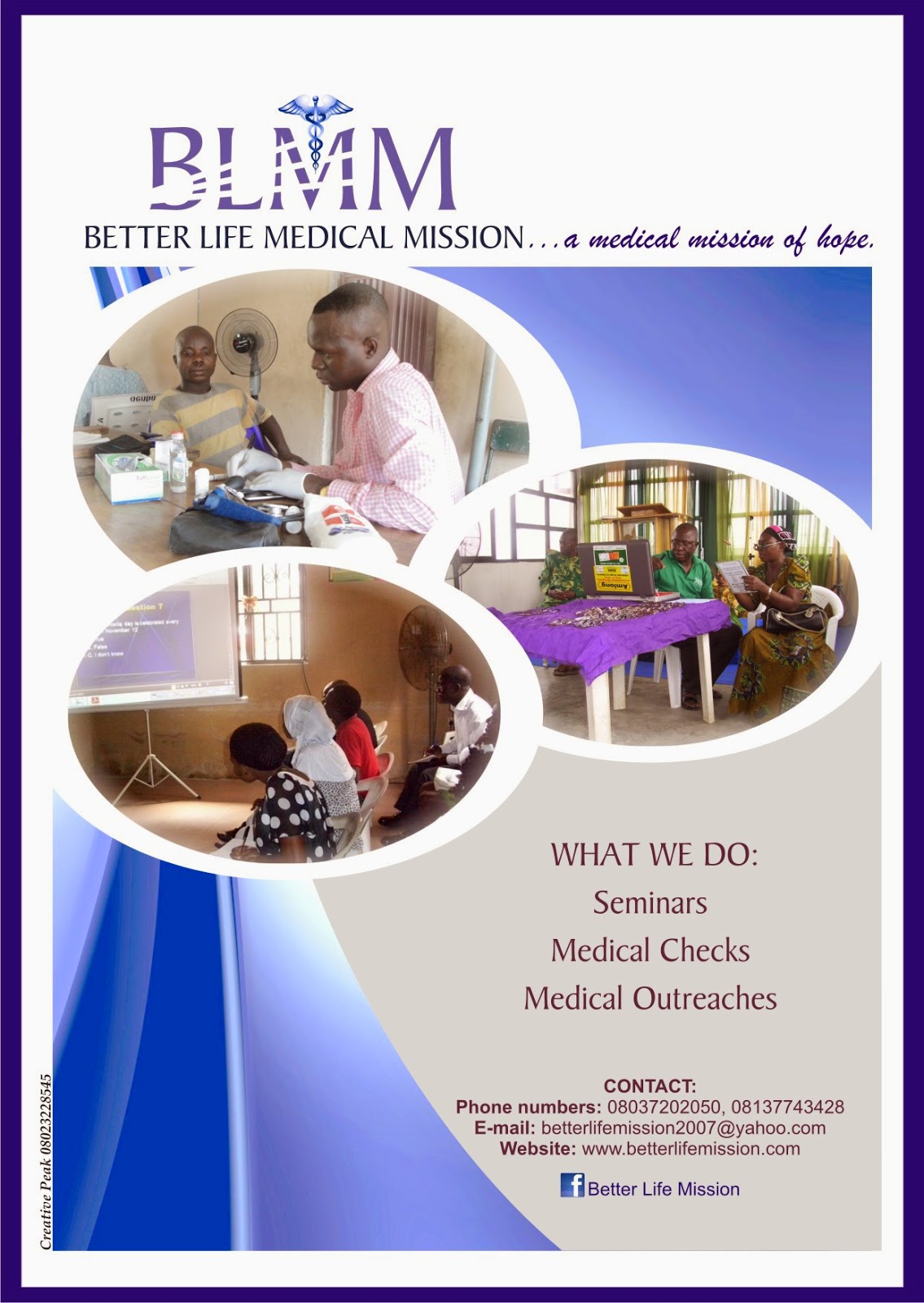
''A MEDICAL MISSION OF HOPE''


                     THE BETTER LIFE MEDICAL MISSION.....a non governmental organization (NGO).
                        visit our websites : www.betterlifemission2007@yahoo.com
                                                   

HOW TO PREVENT TYPHOID FEVER IN CHILDREN


A parent of my sons’ school mate called on phone at the weekend to seek for my expert opinion and requesting for a consultation with her child. We had a very short conversation over the child’s condition. She has been convinced by the previous caregiver that the child has Malaria and typhoid fever.
I tried to convince her that her child may not have typhoid fever based on the history of the illness. The following conversation ensues:
Mrs O: Good evening doctor, I am Mrs O, A parent of your sons’ school mate
Dr: Ok, good evening ma
Mrs O: My Child developed fever a week ago which persisted till now, I have taken her to hospital, we have done test and was told its Malaria and typhoid fever.
Dr Adesanya: How old is your child
Mrs O: less than 2 years
Dr Adesanya: What tests were ordered by your doctor?
Mrs O: MP and Widal test. The result of the test was explained to me that its malaria and typhoid.
Dr Adesanya: Was any test done to screen for infections. Was the ear and throat examined?
Mrs O: Not at all. Could it be teething?
Dr Adesanya: It’s possible, it could be teething or any other conditions that causes fever like viral, bacteria and other infections.
There is need for public enlightenment on diagnosis and management of Typhoid fever, this condition has been severally overdiagnosed, misdiagnosed, wrongly treated. Laboratory tests for typhoid fever is also over requested, inadequate and misinterpreted.
Typhoid fever is a bacterial infection. Children can become very sick or even die without treatment. Typhoid fever is common in areas with poor sanitation.
Signs and symptoms
Signs and symptoms appear about 7 to 14 days after catching the disease and may include a persistent fever that rises gradually to 39ºC to 40ºC, a headache a sore throat, tiredness, low energy, stomach pain, constipation, diarrhoea rash with pink spots on the stomach or chest


 Causes
Typhoid fever is caused by bacteria. The bacteria is most often found in food or water contaminated by an infected person. Infection can also occur when food or drink is served by an infected person who has not washed after using the bathroom.
Risk factors
Having close contact with an infected person increases chances of infection. Children with weak immune systems are also at a greater risk of getting sick. A Child is at higher risk of infection if he or she travels to a country where the fever is common.
Complications
If typhoid fever is not treated quickly, the child may become very ill and develop other complications which may include: severe weight loss, severe diarrhoea, persistent high fever, becoming unresponsive, delirium or hallucinations
Laboratory test
Widal test may suggest infection with salmonella typhi however, they are diagnostic because of the number of false-positive and false-negative.Isolation of Salmonella( bacteria that causes typhoid) from cultures of stool, blood, urine, or bone marrow are necessary to confirm the diagnosis of typhoid fever.
Monitor the fever and complete the antibiotics
The fever and any pain usually go away 48 hours after starting antibiotic therapy. It is important to complete the antibiotics according to prescriptions inorder to prevent recurrence, antibiotic resistance, and complications. 
Prevention
Prevention is the best way to protect the child against typhoid fever. Some simple steps to reduce chances of catching this infection are listed below:
Drink Pure or bottle water
Contaminated drinking water is a common source of the infection. Boil your water and allow to cool before drinking or Stick to pure satchets /bottle water .
Hand washing
Teach children to wash hands frequently. Wash with warm, soapy water before eating food. Also wash after using the toilet. Public education campaigns encouraging people to wash their hands after defecating and before handling food are an important component in controlling spread of the disease. Alcohol-based Hand sanitizer can kill germs when water is not available.
Wash fruits and vegetables thoroughly
Raw fruit or vegetables may have been washed in contaminated water. There is need to rewash the fruits and vegetables.
Vaccinations
Typhoid vaccine is readily available and can be used in children from 2 years of age. Adults can also be given the Typhoid vaccination to prevent them from Typhoid fever.